
Many machines require something to rotate while still receiving electrical power or sending signals. At first glance this sounds simple, but it creates a mechanical problem. Electrical wiring cannot spin endlessly without twisting, wearing out, or eventually breaking. When a machine must rotate continuously, another method is needed to move electricity between stationary and rotating parts.
A slip ring provides that connection.
A slip ring is an electromechanical device that transfers electrical power and signals across a rotating interface. It allows equipment to rotate freely while maintaining a continuous electrical path between the stationary structure and the rotating assembly.
You will find slip rings in many types of equipment where rotation and electrical transmission occur at the same time. Industrial machinery, radar systems, wind turbines, packaging equipment, and medical imaging machines all rely on slip rings to keep their rotating sections connected electrically.
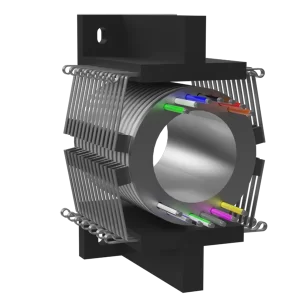
How Slip Rings Transfer Power and Signals
A typical slip ring contains two basic elements: conductive rings and stationary brushes.
The rings are mounted on the rotating portion of the machine. Brushes remain fixed in place and ride against the rings as they turn. As the rings rotate beneath the brushes, electrical current and signals pass through the contact point between the two components.
This arrangement allows electricity to move from the stationary structure into the rotating system without twisting wires. The electrical path stays intact regardless of how many revolutions the machine makes.
While the operating principle is straightforward, real-world designs require careful attention to materials, brush pressure, electrical noise, and mechanical alignment. Small details in the design influence how well the slip ring performs over time.
Why Slip Rings Are Used in Rotating Equipment
When engineers design machines with rotating sections, they must determine how power and signals will reach those moving components.
Without a slip ring, cables would wrap around the rotating shaft until they fail. In some machines designers try to limit rotation or route wires through cable loops, but these approaches reduce system flexibility and introduce maintenance issues.
Slip rings remove that limitation by allowing rotation to continue without interruption. Power, control signals, and data can move through the rotating interface while the machine operates normally.
This makes slip rings useful in many types of equipment, such as:
- Automated production machinery
- Robotic systems
- Radar antennas and surveillance equipment
- CT scanners and medical imaging devices
- Wind turbine nacelles
- Cable and hose reels
- Rotating platforms and indexing tables
- Centrifuge machines
In each case, the rotating portion of the system needs electricity to operate while the structure itself continues to spin.
Situations Where a Slip Ring Becomes Necessary
Slip rings are not used in every rotating machine. They are typically considered when certain conditions appear in the design.
One common situation occurs when electrical power must reach a rotating assembly. Motors, heaters, sensors, and control electronics mounted on a rotating platform all require a steady electrical supply.
Another situation involves signal transmission. Cameras, encoders, and measurement sensors often need to send data between rotating and stationary structures. A slip ring allows that communication to continue while the system rotates.
Slip rings also appear in equipment that must rotate freely for long periods of time. Radar antennas, wind turbines, and rotating inspection systems may operate through continuous rotation. Cable routing methods do not work well in these cases.
Finally, designers often use slip rings to reduce maintenance problems associated with twisted wiring. Allowing the electrical interface to rotate with the machine removes stress from cables and simplifies the overall design.
Industries That Depend on Slip Rings
Slip rings appear in a wide range of industries because rotating electrical interfaces are common in modern equipment.
Manufacturing automation is one of the largest areas of use. Rotating indexing tables, packaging systems, and robotic work cells often rely on slip rings to supply power and signals to moving tooling.
Wind energy systems use slip rings to connect rotating turbine components with stationary control electronics. These connections allow sensors and control systems to communicate while the turbine adjusts its position.
Defense and surveillance equipment also uses slip rings in radar platforms, sensor towers, and rotating camera systems that monitor large areas.
Medical imaging equipment is another example. CT scanners rotate rapidly during imaging, and slip rings allow the system to transfer both power and data during that motion.
Other uses include cranes, cable reels, amusement rides, and inspection equipment where rotating sections must remain electrically connected.
What Engineers Consider When Selecting a Slip Ring
Choosing a slip ring involves more than simply fitting it into the machine. Several technical factors influence the design.
Electrical capacity is usually evaluated first. Engineers must determine how much current and voltage will pass through the slip ring and how many circuits are required.
Rotational speed is another important factor. Some applications operate slowly, while others involve continuous rotation at higher speeds.
Environmental conditions can also influence the design. Equipment operating outdoors or in dusty environments may require protection against contamination or moisture.
Signal performance is often important as well. Many machines transmit communication signals, video, or industrial network data across the slip ring. Maintaining signal clarity requires proper design and material selection.
Finally, the mechanical layout must fit the equipment. Bore size, mounting style, and overall dimensions all play a role in how the slip ring integrates into the system.
Slip Rings in Modern Machine Design
Modern machines often combine power transmission, control signals, and data communication in the same rotating interface. Because of this, slip ring designs have expanded to support multiple electrical functions within a single assembly.
Some units transmit both high current power circuits and low-level signal lines. Others may include channels for high-speed data communication alongside standard electrical connections.
This flexibility allows engineers to simplify rotating systems while keeping electrical connections intact.
A slip ring solves a very practical problem in machine design. It allows electrical power and signals to pass between stationary and rotating parts without twisting wires or interrupting operation.
Whenever a machine contains a rotating section that must remain electrically connected, a slip ring often becomes part of the solution. By allowing rotation and electrical transmission to occur together, slip rings help many types of equipment operate smoothly and reliably.