
Client Overview
A U.S. government research laboratory operating a large indoor centrifuge facility required a reliable 1 Gb Ethernet connection to a rotating payload for high-rate telemetry and control. The centrifuge supports heavy test articles under sustained high-G conditions, with rotational speeds approaching 175 RPM depending on the test configuration.
Project Requirements
The application required a slip ring capable of maintaining stable Ethernet communication during high-G operation while integrating with existing systems. Key requirements included:
- Support for 1 Gb Ethernet communication
- Stable data transmission during sustained high-G loading
- Compatibility with rotational speeds up to approximately 175 RPM
- Integration with existing mechanical and electrical infrastructure
- Coexistence with nearby power circuits within the same assembly
- Support for extended test durations
Technical Challenge
The primary challenge was maintaining Ethernet packet integrity under sustained high-G conditions. This required careful control of signal impedance, as well as proper shielding and grounding through the rotating interface. The design also needed to prevent interference from adjacent power circuits while fitting within established space and interface constraints.
Engineered Solution
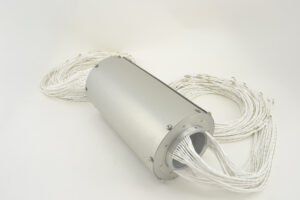
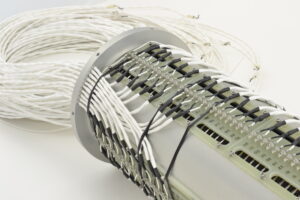
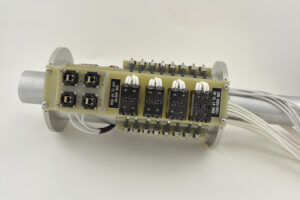
A slip ring assembly was configured to support controlled-impedance differential pairs suitable for copper Ethernet transmission. Dedicated shielding and grounding paths were incorporated to maintain signal quality throughout rotation.
The assembly was packaged to align with the centrifuge’s mechanical envelope and interface requirements, allowing for straightforward integration with the facility’s existing infrastructure.
Design Rationale
The configuration focused on maintaining consistent electrical characteristics for Ethernet signals while managing the effects of high-G forces and nearby power circuits. Shielding, grounding, and internal layout were selected to support stable data transmission within the constraints of the rotating system.
Results
The centrifuge facility completed extended high-G test runs with stable Ethernet performance. The system supported reliable real-time data transfer and command functions for rotating payloads, allowing testing to proceed without the need for alternative transmission methods such as fiber-optic systems.
Conclusion
The final design met the mechanical, electrical, and operational requirements of the centrifuge application. This project demonstrates the ability to support high-speed data transmission through a rotating interface operating under sustained high-G conditions.