
Client Overview
A government research centrifuge facility required high-current power transmission to a rotating test article. The system supported actuators and resistive thermal loads during long-duration test runs, with rotational speeds up to approximately 175 RPM.
Project Requirements
The application required a slip ring capable of delivering high current under continuous rotation while integrating with existing systems. Key requirements included:
- Power transmission up to 100 amps
- Stable performance during extended centrifuge runs
- Operation at rotational speeds up to approximately 175 RPM
- Compatibility with existing voltage distribution systems
- Integration with current slip ring infrastructure
Technical Challenge
The primary challenge was delivering high current through a rotating interface while managing contact resistance, current density, and heat rise over extended operating periods. The design needed to maintain stable electrical performance while aligning with existing system constraints.
Engineered Solution
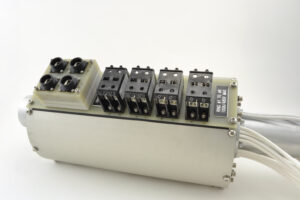
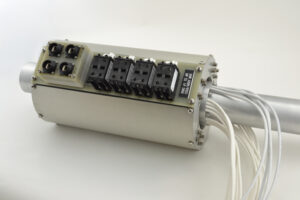
A slip ring assembly was configured with power rings sized to support the required current levels. Ring cross-section and material selection were matched to the electrical load, while silver-graphite brushes were applied with duplication to distribute current and reduce localized wear.
Contact force and material pairing were selected to balance electrical performance with thermal behavior during extended operation.
Design Rationale
The configuration focused on aligning conductor sizing, contact materials, and mechanical loading with the electrical and thermal demands of the application. This approach supported stable current transfer while managing heat generation across the duty cycle.
Results
The power interface delivered stable, continuous current throughout extended centrifuge test runs. The system supported operation of actuators and thermal loads without interruption, allowing the engineering team to focus on evaluating the test article rather than addressing power transmission limitations.
Conclusion
The final design met the electrical, mechanical, and operational requirements of the centrifuge application. This project demonstrates the ability to support high-current power transmission through a rotating interface over extended operating periods.