
Client Overview
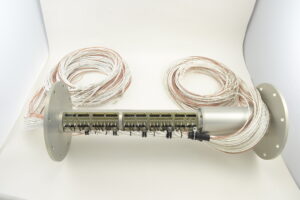
A university research laboratory required a slip ring for a geotechnical centrifuge operating at approximately 130 RPM. The system supported 120 electrical circuits, including sensors, coaxial signals, and power. As a one-off research platform, the project required a custom configuration suited to an academic testing environment.
Project Requirements
The application required a compact, high-capacity slip ring capable of supporting a wide range of signal types within a limited space. Key requirements included:
- Support for 120 electrical circuits
- Integration of sensor, coaxial, and power connections
- Operation at approximately 130 RPM
- Compact assembly suitable for laboratory equipment
- Stable signal transmission across mixed circuit types
Technical Challenge
The primary challenge was accommodating a high circuit count within a confined assembly while maintaining proper electrical separation and signal performance. Special attention was required for ring-to-ring spacing, particularly for higher-voltage circuits, as well as routing coaxial signals alongside power and sensor wiring without interference.
Engineered Solution
Fabricast designed a self-contained slip ring assembly tailored to the application’s electrical and mechanical requirements. Ring spacing was adjusted based on the voltage requirements of each circuit rather than applying uniform spacing across the entire assembly.
Coaxial circuits were routed and shielded within the unit to maintain signal quality, while power circuits incorporated brush duplication aligned with current requirements. The overall design followed a per-ring approach, aligning voltage, current, and spacing with each circuit’s function while selecting materials and geometry suited to the operating conditions.
Design Rationale
The configuration was based on Fabricast’s standard design approach of matching electrical and mechanical characteristics to each circuit within the assembly. This method allowed for efficient use of space while maintaining separation between circuit types and supporting consistent signal performance.
Results
The completed slip ring supported continuous, multi-channel data collection during extended centrifuge test runs. The research team was able to carry out experiments without interruptions related to the rotating interface, allowing full focus on data acquisition and analysis.
Conclusion
Fabricast delivered a custom slip ring solution aligned with the specific needs of a high channel-count research application. The project reflects the ability to configure complex electrical interfaces within compact assemblies while maintaining stable operation over extended use.