
Client Overview
An aerospace supplier developing a Ram Air Turbine (RAT) test system required a slip ring capable of transmitting strain-gauge and other low-level instrumentation signals through a spline-driven rotor. The system operated at speeds up to 6,000 RPM and was used in wind-tunnel and flight-test activity, where vibration and rapid acceleration were present.
Project Requirements
The application required a slip ring designed for high-speed operation and accurate signal transmission under dynamic conditions. Key requirements included:
- Operation up to 6,000 RPM
- Transmission of strain-gauge and low-level instrumentation signals
- Compatibility with a spline-driven rotor
- Resistance to vibration and rapid acceleration
- Integration of a rotor terminal board for clean, serviceable connections
- Support for repeated test cycles
Technical Challenge
The primary challenge was maintaining stable signal transmission for strain-gauge circuits, which operate at very low signal levels and are sensitive to contact noise, vibration, and inconsistent return paths. The design needed to perform consistently at high rotational speeds while supporting repeated testing without degradation in signal quality.
Engineered Solution
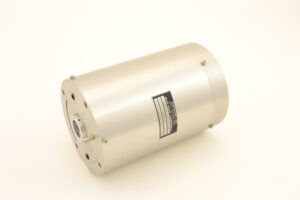
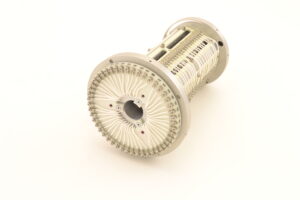
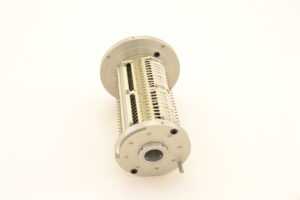
A high-speed slip ring was engineered specifically for instrumentation-only use. Brush materials and contact pressure were selected to reduce electrical noise while maintaining consistent contact during high-speed rotation.
Signal routing within the assembly was arranged to maintain stable return paths for strain-gauge circuits. The design excluded power circuits, focusing entirely on instrumentation performance. A rotor terminal board was incorporated to support clean wiring layout and simplify maintenance and configuration changes during testing.
Design Rationale
The configuration was based on aligning contact materials, mechanical design, and signal routing with the specific needs of low-level instrumentation at high rotational speeds. Emphasis was placed on maintaining consistent electrical paths and minimizing sources of noise within the rotating interface.
Results
The slip ring delivered stable, low-noise signal transmission throughout high-speed testing. During wind-tunnel and flight-test activity, the system supported reliable strain-gauge data collection across repeated test cycles, allowing the development team to proceed with evaluation and qualification work without interruption from the rotary interface.
Conclusion
The final design met the mechanical, electrical, and operational requirements of the application. This project demonstrates the ability to support accurate signal transmission in rotating systems operating under high speed and dynamic conditions.